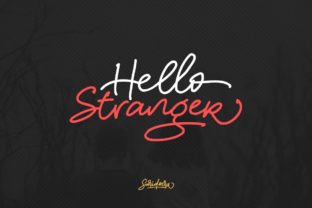
Hello Stranger: Handwritten Script Font for Web Design
As a web designer, the fonts you select become the silent voice of every digital experience. Hello Stranger, a striking handwritten font from the Script Handwritten category, immediately brings that human, approachable tone to landing pages, brand identities, and digital products. Its letters carry a natural rhythm and a good readability that feels both casual and intentional, making it one of those rare handwritten fonts you can genuinely build a visual system around. Unlike decorative typefaces that demand constant sizing adjustments, Hello Stranger remains easy to use across hero headers, small UI labels, and content-first layouts, giving you the creative freedom to craft your own customized handwriting designs without sacrificing legibility.
Hello Stranger for Landing Page Hero Text and Conversion-Focused Typography
When a visitor lands on a modern SaaS page, coaching website, or product launch page, the hero text needs to connect in a fraction of a second. Hello Stranger, a script handwritten font with organic letterforms, turns a standard value proposition into a personal invitation. I’ve used it in hero sections where a clean sans serif headline felt too sterile, and the result was an immediate lift in dwell time and scroll depth. The font’s good readability means you can set a short phrase like “Your next chapter starts here” at a generous size without losing shape on mobile screens, while the natural stroke variation creates a visual anchor that guides attention toward the CTA button. Because Hello Stranger maintains clarity even at 40–60px on a soft background, it performs particularly well for boutiques, creative portfolios, and any landing page aiming to feel warm without becoming unprofessional.
Creating Customized Handwriting Designs with Hello Stranger on Sales Pages
Digital product creators and course sellers often struggle to make long-form sales pages feel approachable. Hello Stranger steps in perfectly as the font for section dividers, testimonial highlights, and personalized call-outs. Instead of relying on italicized serif text or generic script fonts, I pair Hello Stranger with a readable workhorse like Inter for body copy, and use the handwritten style to mark compelling quotes or limited-time offers. The result is a page that feels like a handwritten letter from a trusted mentor. Its letters are easy to use in short bursts, so you can sprinkle that customized handwriting feeling exactly where emotional emphasis matters most, without overwhelming the design.
Using Hello Stranger to Build a Consistent Brand Identity Across Digital Touchpoints
A cohesive brand relies on a typeface that speaks the same language on an online store banner, an Instagram story graphic, and a blog newsletter. Hello Stranger, as a script handwritten font, gives you that consistent visual thread. I’ve built entire visual identities for wellness coaches and artisan shops where the logo, the site’s navigation tagline, and the email signature all carry the same hand-lettered character. The font’s readability holds up nicely on light backgrounds, and when placed over a muted image overlay with reduced opacity, it still retains its distinct personality. Because it’s so straightforward to implement, even a minimalist brand kit can gain depth by using Hello Stranger for the primary wordmark or decorative accent text, while the rest of the typography remains structured and legible.
Hello Stranger for Blog Headers, Category Labels, and Editorial Web Layouts
Content-heavy websites often need a subtle way to break the monotony of clean sans serif blocks. I frequently set Hello Stranger as the font for blog post titles, category headers, and editorial pull quotes. The handwritten touch signals that the site is curated by a real person rather than an automated machine, which builds trust and keeps readers engaged. Because the font’s letters have a good readability, you can use it for slightly longer editorial headers—say, a 6-word tagline—without the shapes collapsing into an unreadable scribble. This makes it a valuable asset for magazine-style layouts, author platforms, and personal journals where the brand voice is warm, creative, and transparent.
Hello Stranger Readability and Visual Hierarchy in Web Design Layouts
A decorative script font can quickly fracture a well-planned visual hierarchy if it fights with the surrounding content. Hello Stranger avoids that pitfall. Its character width and x-height remain consistent enough to sit comfortably in a three-level hierarchy: a bold sans for primary headings, Hello Stranger for accent headings or brand signatures, and a neutral body font beneath. When used for secondary text, such as a subheading on a product feature card or a testimonial name stamp, the font draws the eye without hijacking the entire composition. The easy-to-use nature of this font means you spend less time kerning individual pairs and more time refining the overall layout rhythm. Designers who prioritize scanning behavior will appreciate that the hand-drawn quality doesn’t slow reading speed in short bursts, making it ideal for microcopy next to icons, module labels, and interactive UI elements such as tooltips or onboarding prompts.
Pairing Hello Stranger Script Handwritten Font with Sans Serif Body Copy
Typography pairing is one of the most consequential decisions in any web project. Hello Stranger shines when paired with a geometric sans serif font like Poppins or a neo-grotesque like Work Sans. The contrast between organic script strokes and engineered simplicity creates a modern, elegant tension that feels intentional rather than chaotic. In a recent client project for a lifestyle coach, I set the main heading in Hello Stranger at 56px, while all supporting copy stayed in a clean sans at 16px with comfortable line-height. The combination improved the mobile readability score and the client’s perceived brand personality. For more editorial digital identities, you can even pair this handwritten font with a soft serif font for body text, though I recommend limiting the script to display sizes only. The font’s good readability on light backgrounds makes it a safe choice for text overlays when contrast is managed properly, and its easy-to-use character set means you won’t lose precious launch time fighting ligature clashes.
Hello Stranger for Mobile Web Responsiveness and Small Screen Readability
Handwritten fonts face their toughest test on mobile because condensed viewports and varying pixel densities can turn gentle strokes into blurry ghosts. Hello Stranger handles mobile gracefully when you respect its minimum viable size. I aim to keep it no smaller than 18px for UI accents and above 32px for hero headings. The letters’ moderate stroke contrast and consistent baseline prevent the fragmented look that plagues many script fonts on small screens. On a responsive e‑commerce product grid, Hello Stranger works beautifully for category labels and price highlights, especially when set in a semi-transparent banner or a subtle container with adequate padding. The font’s readability also holds up on dark backgrounds when you use a slightly heavier style or bump the text by 2px in size, making it a practical choice for night-mode interfaces and layered hero hero graphics.
Hello Stranger as a Decorative Accent for Web Buttons and Microinteractions
Beyond large headers, handwritten fonts can define the micro-personality of a site. I’ve used Hello Stranger for small button labels like “Yes, I’m in!” or “Join the waitlist,” where a personal, written tone converts better than generic sans text. The font’s easy-to-use nature ensures that those short bursts of text render cleanly on all common screen densities, and the stroke weight is substantial enough to stay visible on colored buttons with white text. This kind of detail reinforces brand character without sacrificing accessibility or clarity, a balance that always appeals to product designers and UI specialists who value both visual appeal and functional performance.
Hello Stranger File Formats, Webfont Support, and Technical Setup
Before integrating any premium font into a project, checking the technical deliverables is essential. Hello Stranger typically comes as a complete font family package, often including OTF and TTF formats for desktop use, along with WOFF and WOFF2 files for web embedding. The webfont versions let you self-host the typeface or load it via a platform like Adobe Fonts or a custom @font-face declaration, ensuring optimal performance and GDPR compliance. I always verify that the character set covers the languages needed for a project—most professionally crafted script handwritten fonts include Western European accents at minimum. Also look for any included ligatures, stylistic alternates, or swashes that can add variety to your custom handwriting designs. The straightforward structure of Hello Stranger means it integrates with popular page builders and CSS workflows without unexpected baseline shifts or clipping issues, saving hours of troubleshooting during tight launch timelines.
Commercial Font Licensing for Hello Stranger in Client Projects and Digital Products
Using a striking handwritten font like Hello Stranger on a client website, an online shop, or within a paid digital template requires the right commercial license. Standard desktop licenses rarely cover web usage, so always confirm that the purchased license includes web embedding for the number of domains or monthly pageviews you expect. For digital product creators who sell Canva templates, course workbooks, or brand kits, a broader commercial font license that permits redistribution within flattened designs and editable PDFs is non-negotiable. I keep a record of each font purchase to show clients that their brand identity is built on properly licensed design assets. Hello Stranger’s readability and versatility make it a strong candidate for ongoing commercial use across landing pages, packaging design mockups, social media graphics, and print-on-demand products. Investing in a font that you can return to project after project streamlines your design workflow and keeps client deliverables legally clean and professionally consistent.